
 EN
Why Wet Toilet Paper Delivers Superior Cleansing and Hygiene
The Limitations of Dry Wiping: Incomplete Residue Removal and Microbial Persistence
Dry toilet paper relies solely on friction to remove solid waste—yet it often smears rather than lifts residue, especially within perianal skin folds. Because dry, porous paper cannot dissolve or suspend fecal matter, microscopic remnants frequently persist even after multiple passes. This residual layer sustains bacteria, contributing to odor, itching, and irritation. Repeated rubbing further increases mechanical stress, raising the risk of microabrasions—particularly problematic for individuals with sensitive skin, hemorrhoids, or postoperative needs. Effective hygienic cleansing requires both mechanical action and moisture; dry wiping delivers only half.
How Moisture Enhances Mechanical Removal and Reduces Skin Microtrauma
Wet toilet paper transforms cleansing from abrasive dry wiping into a gentle lift-and-wipe action. Moisture softens dried residue and reduces its adhesion to skin, enabling thorough removal in fewer passes. Lower friction means less disruption to the stratum corneum and fewer microtears—critical entry points for irritants and microbes. A damp sheet also conforms more closely to skin contours, reaching areas dry paper misses. Dermatological guidance consistently favors moist cleansing for compromised or inflamed perianal skin, as it preserves barrier integrity without aggressive scrubbing. Even plain water improves the coefficient of friction and enhances soil suspension—making wet toilet paper a clinically sound choice for comfort and hygiene.
Flushable Wet Toilet Paper: Meeting Plumbing-Safe Standards Without Compromise
Understanding True Flushability: ASTM D6868 and EN 13432 Compliance
True flushability demands performance across two distinct phases: structural integrity during use and rapid, reliable disintegration after flushing. While standards like ASTM D6868 (for biodegradable polymer–paper composites) and EN 13432 (for industrial compostability) provide useful benchmarks, neither guarantees safe passage through real-world plumbing. Validated flushability requires sewer-specific testing—including slosh-box dispersion, wet tensile loss, drain-line transport, and pump clearance. A product may fully disintegrate in a lab beaker yet clog low-flow toilets or municipal pumps due to persistent sheet strength or fiber entanglement. Only claims citing specific protocols and pass/fail criteria—such as those aligned with the International Water Services Association’s (IWSA) GD4 guidelines—offer meaningful assurance. Without sewage-pathway validation, “flushable” is a marketing term—not a functional guarantee.
Avoiding 'Flushable' Mislabeling: How to Identify Verified Wet Toilet Paper
Look beyond the word “flushable.” Verified products explicitly name the test protocol they’ve passed—e.g., “passes IWSA GD4 under 10-second dispersion at 150 rpm”—and display certification marks from independent bodies like NSF International or the Water UK Flushability Scheme. Avoid thick, cloth-like, or heavily wet-laid sheets, which resist breakdown; true flushable variants use shorter fibers and minimal wet-strength additives. A simple home check: drop a sheet into cold water and agitate gently for 2 minutes—if it remains intact, it’s not suitable for flushing. Request technical data sheets and third-party test reports from suppliers when evaluating reliability. Rigorous verification protects plumbing infrastructure, prevents costly backups, and ensures environmental claims align with real-world performance.
Skin-Safe Formulations: Hypoallergenic, pH-Balanced, and Alcohol-Free Wet Toilet Paper
Addressing Perianal Sensitivity: Why Ingredient Transparency Matters
Perianal skin is up to 40% thinner than facial skin and lacks robust sebum production, making it uniquely vulnerable to irritation. Ingredient transparency is therefore non-negotiable: vague terms like “natural” or “hypoallergenic” carry no regulatory weight. A clinically supportive formulation—like one validated in a 2012 BMC Pediatrics study—uses a 97% purified water base, maintains a skin-mimicking pH of ~4.9, and avoids alcohol, synthetic fragrance, and harsh surfactants that compromise barrier function. Transparent labeling should list all components, including preservatives and pH buffers, so users can assess compatibility with sensitive or post-treatment skin.
Key Soothing Agents: Aloe Vera, Chamomile, and Prebiotic Fibers in Premium Wet Toilet Paper
Premium wet toilet papers enhance baseline gentleness with targeted, evidence-informed actives. Aloe vera supports hydration and visibly calms redness; chamomile offers mild anti-inflammatory benefits; and prebiotic fibers—such as inulin or fructooligosaccharides—help maintain a balanced perianal microbiome by nourishing beneficial commensal bacteria. These ingredients deliver maximum benefit only within alcohol-free, pH-balanced, dermatologically tested bases—because a harsh vehicle negates soothing intent. Prioritize full ingredient disclosure and avoid products where botanical extracts are paired with drying alcohols or synthetic fragrances, regardless of marketing emphasis.
Practical Adoption: Portability, Discreet Packaging, and Real-World Use Scenarios
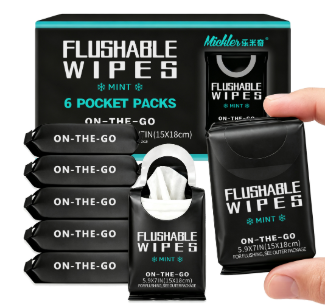
Practical adoption starts with smart packaging: individually wrapped or resealable travel packs fit seamlessly into pockets, handbags, or carry-ons—enabling consistent hygiene without drawing attention. Discreet design supports daily use in shared offices, guest bathrooms, gyms, and air or rail travel. Real-world applications include menstruation, postpartum recovery, hemorrhoid management, and conditions like IBS or ulcerative colitis—where dry paper alone risks residue retention or tissue trauma. For caregivers, portable wet toilet paper enables dignified, standardized support during hospital stays or outpatient visits. Since usage is typically low-volume, always follow local plumbing guidance and choose packaging that clearly states flushability status or disposal instructions. Keeping a compact pack in a desk drawer, glove compartment, or diaper bag lowers the barrier to sustained, moisture-assisted hygiene—turning best practice into everyday habit.
FAQ
Why is dry toilet paper considered less effective for hygiene?
Dry toilet paper relies solely on friction, often leaving behind residues and increasing the risk of skin irritation or microtears.
How does wet toilet paper reduce skin trauma?
Wet toilet paper softens residues and reduces friction, which helps avoid microtears and ensures thorough cleansing even in sensitive areas.
What makes wet toilet paper flushable?
True flushable wet toilet paper undergoes sewer-specific testing and meets strict guidelines such as IWSA GD4. It disintegrates quickly and avoids clogging plumbing systems.
How can I check if wet toilet paper is truly flushable at home?
Soak a sheet in cold water and gently agitate it. If it disintegrates, it’s likely flushable. Otherwise, improper breakdown may cause plumbing issues.
What ingredients should I look for in skin-safe wet toilet paper?
Look for ingredients like purified water, aloe vera, chamomile, or prebiotic fibers, combined within a pH-balanced, alcohol-free formula.
Can wet toilet paper be used for specific conditions like hemorrhoids or irritable bowel syndrome?
Yes, wet toilet paper is suitable for sensitive conditions like hemorrhoids or IBS, as it minimizes irritation and ensures better hygiene compared to dry paper alone.
Table of Contents
- Why Wet Toilet Paper Delivers Superior Cleansing and Hygiene
- Flushable Wet Toilet Paper: Meeting Plumbing-Safe Standards Without Compromise
- Skin-Safe Formulations: Hypoallergenic, pH-Balanced, and Alcohol-Free Wet Toilet Paper
- Practical Adoption: Portability, Discreet Packaging, and Real-World Use Scenarios
-
FAQ
- Why is dry toilet paper considered less effective for hygiene?
- How does wet toilet paper reduce skin trauma?
- What makes wet toilet paper flushable?
- How can I check if wet toilet paper is truly flushable at home?
- What ingredients should I look for in skin-safe wet toilet paper?
- Can wet toilet paper be used for specific conditions like hemorrhoids or irritable bowel syndrome?